Showing posts with label art. Show all posts

January 27, 2007

New art: Kaoru Hirano


Installation artist Kaoru Hirano pulls apart the fine weave of clothes, thread by thread, and rebuilds their forms by retying the threads.

Her new work at Ginza's Shiseido Gallery is a reworking of an old dress once worn by a friend. After two months of pulling apart and tying back together (Hirano started the work in November), the concrete shape of the dress has morphed into an airy cobweb of multicolored fibers.

The installation, "Aerosol," is a work in progress -- you can see Hirano add to the piece at the gallery's weekly "public viewings."

She told me during Saturday's public viewing:

"You can take apart someone's clothes, but there's a history that remains in the fibers. This work rebuilds that history."

The exhibit, part of Shiseido's art egg project showcasing young artists, runs till Sunday, Feb. 4. The next public viewing session is on Feb. 3.

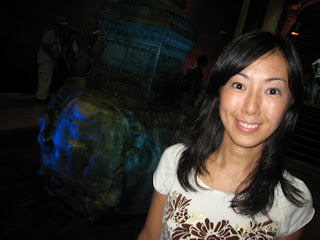
Image from Tokyo Art Beat

January 21, 2007

Tokyo gets a new museum


Kajima Corporation

Tokyo got its latest cultural infusion on Jan. 21 with the launch of the National Art Center, Tokyo, or NACT, a mammoth new museum just minutes from the busy station crossing,

Designed by Japanese architecture legend Kisho Kurokawa, the NACT is another corner of the so-called "Art Triangle Roppongi" with nearby Mori Art Museum and the renovated Suntory Museum of Art, which opens on March 30.

The NACT's undulated glass facade might look grander if you could actually see the whole length of it. But it's hard to -- the building is squashed in between an awkwardly positioned research center and rows of houses, and you can't seem to walk far enough away to take in the whole structure.

(There is a great view of the museum, though, from the observatory on the 51st floor of Roppongi Hills Mori Tower.)

Entering the NACT creates a sense of walking into an unexpectedly large space -- 14,000 sq. meters of it, in fact. The giant foyer with two cafes perched on top of separate flower-pot-shaped concrete blocks is a nice eccentric touch, but the layout is otherwise very standard.

Showing till Feb. 4, free of charge, is "Power of Expression, Japan," a wild walk through Japanese art and pop culture in the 20th century: Godzilla suits and Space Invader arcade machines to works by contemporary Japanese artists like Tabaimo and Yasuhiro Suzuki.

Suzuki's "Blinking Leaves" is a particularly fun piece of art. You can get a sense of it here: mabataki

The NACT, which has no permanent collection of its own, is also showing "Living in the Material World -- 'Things' in Art of the 20th Century and Beyond." The center has a restaurant, three cafes and an art shop.

NACT English Web site

January 10, 2007

Coming to a gallery near you: Homeless architecture


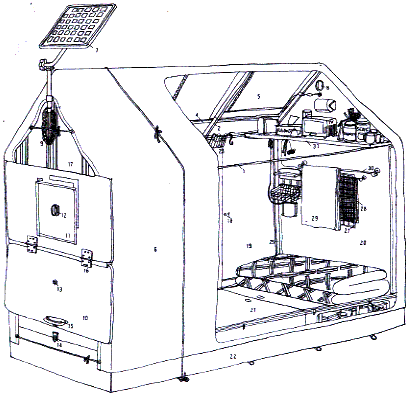
Sketch by Kyohei Sakaguchi

March 21, 2006
By Hiroko Tabuchi

Like many Zen-inspired structures, Okawara's hut is a monument to simplicity. The size of a large tool shed, the wooden building blends seamlessly with the surrounding park. His door opens to a full view of Tokyo's Tama River.

Okawara is not your typical architect: He's homeless. But the elegant austerity of his hut and thousands of others like it has turned the country's destitute into unwitting purveyors of an emerging art form that's catching the eye of international connoisseurs.

The dwellings -- carefully built, meticulously kept and collapsible for quick movement when police move in -- have inspired a rash of art books, and Japanese promoters are discussing them with curators in North America and Europe.

"These homes embody simplicity and functionality and are at one with their environment, like the tea house of Sen Rikyu," said architect Kyohei Sakaguchi -- author of a study of homeless architecture titled "Zero Yen Houses" -- referring to a 16th-century tea master who preached frugality through the art of tea ceremony.

Read the rest of the article on The Japan Times homepage (registration required)

Kyohei is running a workshop and exhibit at the World Social Forum 2007 in Nairobi, Kenya, till Jan. 28.

>>See Kyohei Sakaguchi's Web site>>